Technical Writing Portfolio
With my background in DevOps and system administration, I write for developers as a peer. My portfolio includes a variety of developer content, including documentation, blog posts, case studies, video scripts, and more.
Download Documentation Samples Download Resume
Documentation
JSON Schema Tutorial
Step-by-step guide to annotating JSON documents using JSON Schema, with code samples and key concept explanations.
PKS Load Balancers Overview
Overview of load balancer types and configurations in Pivotal Container Service (now Tanzu Kubernetes Grid Integrated Edition) deployments.
Technical Blog Posts

Postman Product Updates
Monthly product update series written as a blog post and adapted into a video script.
Performance testing upgrades
Traditional performance testing measures latency and throughput, but it doesn't tell you if your API is still behaving correctly under load. So, we've rebuilt the performance testing engine from the ground up. It now supports significantly higher load with predictable resource usage. And now you can run your existing pm.test() assertions using performance tests. Validate correctness and performance at the same time using the collections you already rely on for functional testing, so you can see exactly when and where behavior breaks as load increases.
CI support for performance testing is also in open beta. This lets you run performance tests headlessly via the Postman CLI, so you can reuse tests as release gates. Catch concurrency bugs earlier and ship APIs that behave predictably under real-world traffic.
New Errors tab
Speaking of testing, when collection runs fail, the new Errors tab speeds up debugging. Test failures appear in Failures. Unexpected errors like network issues, timeouts, or script errors appear under Errors and they're grouped by request. Jump directly to the failing request and spend less time digging through logs.
Agent Mode integrations
Agent Mode also got some updates this month. You can now create GitHub issues and Jira issues via Agent Mode with context carried over automatically.
Next up, better notifications for Slack and Microsoft Teams. You can now customize the frequency of Postman notifications in your Slack and Teams channels. Instead of getting every update, notifications now summarize new developments in your Postman workspaces. You can also customize your notifications by day of the week and time of day in a time zone you choose, so you can stay on top of API changes without overloading your channels with noise.
AI models and MCP server
Next, we're excited to introduce more flexibility with AI models. Experimenting with different models usually means switching platforms and managing separate API keys. We've redesigned AI requests to include a new provider selector and Bring Your Own Model support. Connect any OpenAI-compatible endpoint, whether it's a cloud provider, self-hosted deployment, or a local model on your machine. Test and compare models directly in Postman Collections without switching tools.
And while we're talking about AI, Postman's MCP server now includes new ways to work with APIs. Connect Postman's MCP server to Claude Desktop, Cursor, VS Code, and other MCP-compatible coding agents. The MCP server can now generate idiomatic, well-organized code from your API definitions and test your APIs by running collections directly, so your AI assistants have more context about your APIs and can help you build faster.
Team Notebooks and workflow updates
Team Notebooks lets your team collaborate on creating interactive API documentation and they're now available to use directly in Postman. Plus, you can now save time by using Agent Mode to quickly create comprehensive Notebooks. Describe what you want to build and Agent Mode will assemble a structured Notebook with guidance, runnable requests, and code snippets.
Good news for our Linux users: the Postman CLI now natively supports Linux ARM64. Run tests on ARM-based CI infrastructure without emulation for faster execution and smoother performance.
A few more improvements this month: create Jira issues directly from monitor results, sort requests alphabetically inside collections, see console logs in collection run results, and control what syncs between specs and collections in Spec Hub.
So that's what's new this month at Postman. Faster workflows, tighter integrations, and APIs that scale predictably. Give them a try and let us know what you think in the Postman community. And as always, keep it 200.
How Postman Uses Postman
Interview series exploring how Postman employees across the organization use their own platform. I conducted and wrote interviews spanning data science, AI, design, testing, and monitoring.
What is XML?
Introduction to XML covering its fundamentals, benefits, challenges, and usage in Postman.
What is API Encryption?
Explains API encryption, its importance, challenges, best practices, and how Postman helps.
Event Recaps
POST/CON Keynote Coverage
Three-part series recapping Postman's 2025 conference keynote, translating live announcements into in-depth editorial content on API development workflows, distribution, and AI orchestration.
API Specifications Conference 2022
Session recaps from the API Specifications Conference, covering OpenAPI, GraphQL security, contract testing, open data, and JSON Schema in production.
Case Studies
6 River Systems: Warehouse Automation with JSON Schema
An in-depth exploration of how 6 River Systems leverages JSON Schema to streamline warehouse robotics operations and enhance data validation processes.
Salesforce: Scaling API Sharing for Developer Success
Analysis of Salesforce's approach to sharing APIs at scale while maintaining an excellent developer experience through their public workspace strategy.
Print Publications
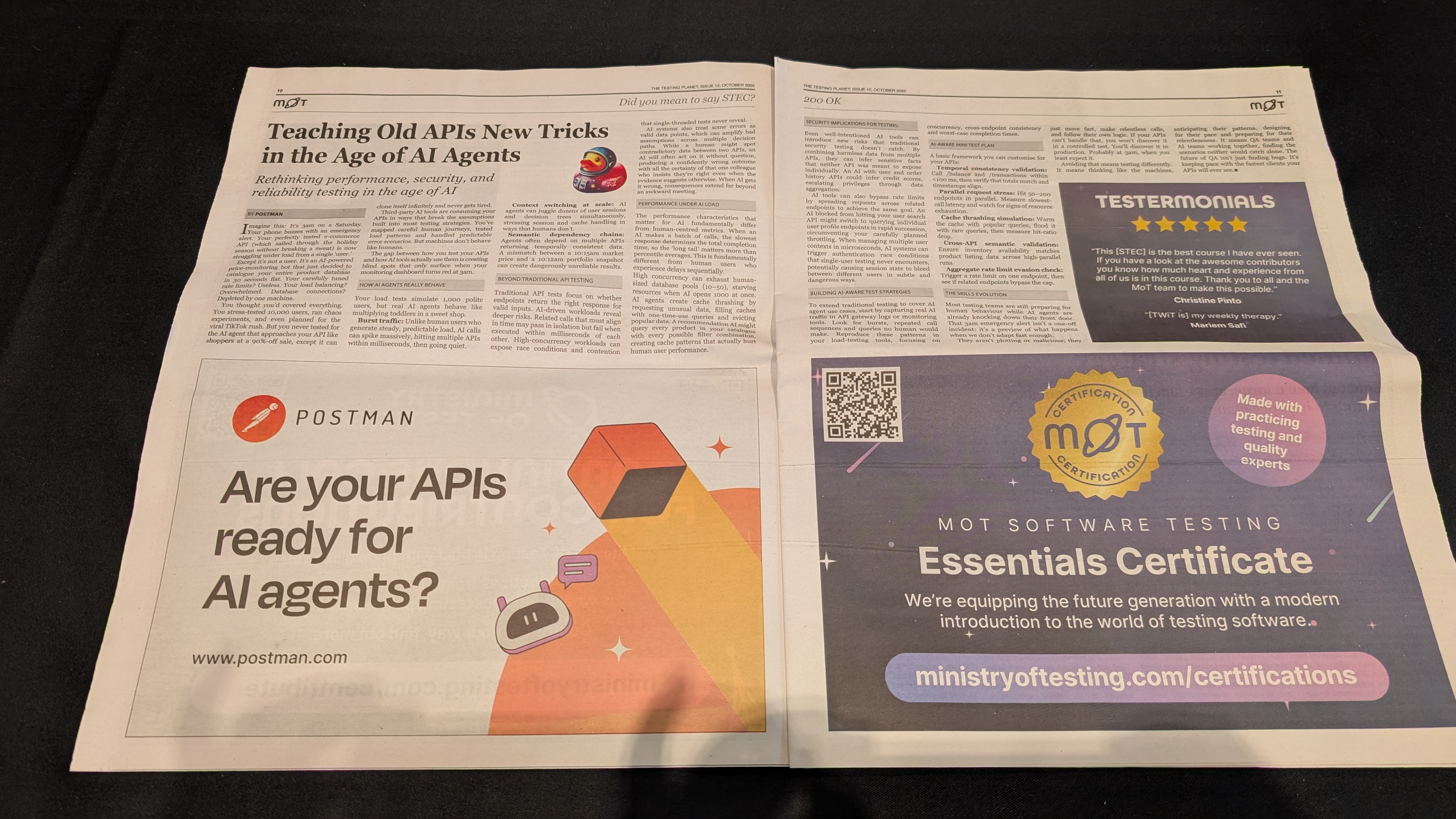
Teaching Old APIs New Tricks in the Age of AI Agents
Published in Ministry of Testing newspaper for TestBash Brighton 2025. Article explores rethinking performance, security, and reliability testing in the age of AI agents.